Designing with Empathy: Methods to Understand Users
Design thinking is a human-centered and creative way of solving problems. The main purpose is to keep the user in mind during every step of the design process, starting from square one. Having a comprehensive understanding of the user is top priority, and merely targeting demographics based on averages and data is quickly becoming a practice of the past. With a market saturated with every product known to humankind, so many products fail because they weren’t designed with the user in mind.
What is missing is a main tenet of design thinking: empathy.
The first step of design thinking is empathy, a deep understanding of problems and realities of the people you are designing for. The purpose is to learn the difficulties people face as well as uncover their needs and desires to explain their behaviors. It’s the first step in design thinking, before the problem is even fully established. Empathic research aims to understand and meet the needs of the people who will ultimately use the products that are designed.
Empathic research methods are designed to allow designers to observe and gather information on the problems they are trying to solve, before making assumptions. They emphasize the importance of understanding an issue or experience from a user’s perspective, free of a designer’s initial assumptions or judgements.
There is a constantly growing list of different ways to conduct empathic research, but here are a few tried and true ways to conduct empathic research at different stages of a project:
Observe and Report
The ‘What? Why? How?’ Method
The ‘What? Why? How?’ method is a good, cost-effective way to begin empathic research at the beginning of a project. The main goal of the ‘What? Why? How?’ method is to gather as much information as possible about a user, service or environment and begin to build assumptions. Researchers should observe what the user is doing, how they’re doing it, and then go deeper to understand why they’re doing it. Once all the questions have been answered, researchers can introduce more specific questions, getting closer to the heart of the problem.
Storyboarding
Another cost-effective place to begin is storyboarding. A series of sketches aim to explain the user experience, step by step. This method is great for highlighting pain points, problems, or any friction the user might have during their experience as well as any gaps in previous observations. Another excellent first step in research, storyboarding can be used to gain alignment and uncover the next phase of research. Similar to how it’s used in filmmaking, storyboarding can also help illustrate a user’s story in an easily-readable and memorable way.

Storyboards don’t have to be anything fancy, they just have to get their point across / via nngroup.com
Conduct Interviews
Contextual Interviews
It’s important to deeply know the user as well as their environment. Human-centered interviews, in the context of the environment either the service or the experiment takes place in, allow researchers to observe, describe, and try to understand user behavior. Environment is a key part of these interviews. A lot of contextual details are often lost in traditional, focused interviews. By seeing what users do in the context of their environments, it becomes easier to see how products and services are really used. This method of empathic research is particularly valuable in industries like retail and finance. For example, a clothing brand wants to improve its online shopping experience. An interviewer can observe customers shopping on their devices and interacting with the UI. The interviewer can then speak with the customers and find ways to make the experience easier, faster, and more enjoyable.
Empathic Interviews + the 5 Whys method
This method is more of a traditional one-on-one interview, with the objective being a deep dive into the assumptions and solutions to a user’s problem. The goal is to dig deeper with every answer by asking a total of five “why?” questions. For example, you may ask a user: “Why are you no longer happy with this service?” Once the customer has answered, continue unpacking the issue by asking, “…and why do you feel that way?” When used in moderation, this method allows researchers to move past surface level answers and find the root cause of a problem.
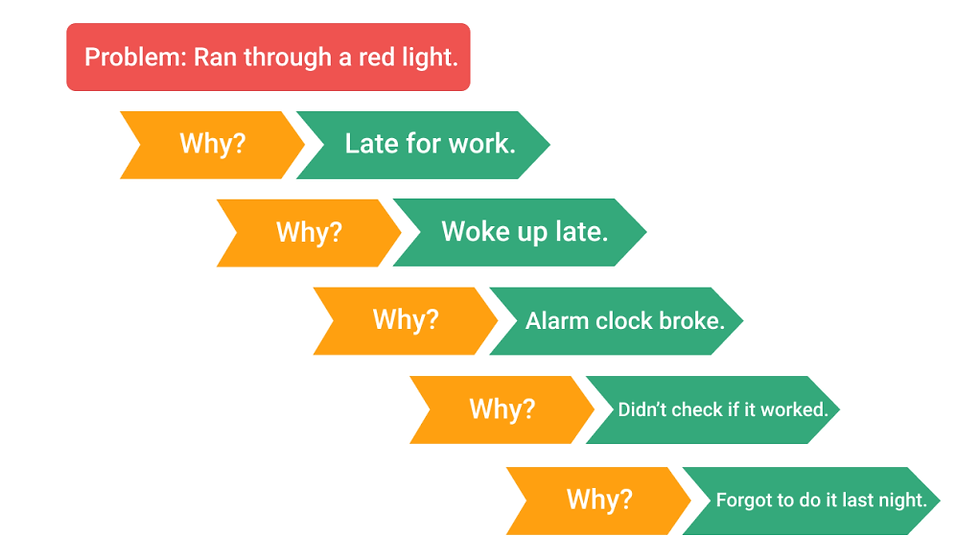
Continuing to ask why allows researchers to dig deeper into a problem / via kanbanize.com
Collaborate
Love Letter/Breakup Information
At a basic level, brand/user relationships are similar to personal relationships. This research method gives insight into the user experience by eliciting feelings based on real life experiences and interactions. Users are asked to write a letter quite literally to a brand or service they either love or do not. The technique is familiar, easy to understand, and can be completed in a short amount of time. Researchers can use the wording, tone, and content of these letters to determine pain points and insight into a user’s core values. This method was first developed in 2009 by Smart Design, a global innovation consulting firm, and unveiled at IIT’s 2010 Design Research Conference.
Engage with Extreme Users
Extreme users can be described as the people on either end of the spectrum of users of a product or service. Often left out of averages, these users are fewer, but they are the people who make the greatest demands of design and often their needs are somewhat amplified. These users are knowledgeable, proactive, and can provide points of view outside of a set demographic. Cofounder of the design company IDEO Bill Moggridge argued that only by understanding the viewpoints of a full range of people is it possible to avoid the pitfall of designing for yourself. An example of engaging with users outside the average is OXO founder Sam Farber creating the line of Good Grips kitchen products after he saw his wife Betsey having trouble holding her peeler due to arthritis.
Co-Creation
Similar to engaging with extreme users, this method brings in people who are part of a key demographic or are in the criteria of the project and allows them to share their point of view. A great part of using co-creation early in the design process is that you uncover insights that you would normally have to wait a couple of steps to get into. Co-creating can also provide ideas and jumping off points that can be used in the ideation and prototyping stages. For example in 2012, to meet changing product demands in the face of a growing appetite for craft beers, Anheuser-Busch held a brewing competition that was combined with consumer tastings to develop a new craft beer.

Co-creation can help with multiple steps in the design process / via bresslergroup.com
In the process of empathizing with users, it becomes possible for designers to uncover unidentified, unmet needs and unimagined potential solutions, fueling innovation, creativity, and industry change. Empathy isn’t just a factor in design thinking; it’s crucial to a design’s success.
Photo by Van Tay Media on Unsplash
References:
Dam, R. F., & Siang, T. Y. (n.d.). Design Thinking: Getting Started with Empathy. The Interaction Design Foundation. Retrieved September 16, 2021, from https://www.interaction-design.org/literature/article/design-thinking-getting-started-with-empathy.
RocketAir. (2018, September 18). Designing with empathy for your users. Medium. Retrieved September 16, 2021, from https://blog.prototypr.io/designing-with-empathy-for-your-users-5010b9b19ba3.
Santee, A. (2018, November 17). Brand Research Method: The Love Letter and the Breakup Letter. Anthropologizing. Retrieved September 16, 2021, from https://anthropologizing.com/2014/01/03/design-research-method-the-love-letter-and-the-breakup-letter/.
Wiecek, A. (2018, August 13). 9 Best Empathic Research Methods to Help You Dig Deeper & Truly Understand Your Customer. Medium. Retrieved September 16, 2021, from https://medium.com/@alewiecek/9-best-empathic-research-methods-to-help-you-dig-deeper-truly-understand-your-customer-5a9b56c45e59.


Comments